“Everyone has a plan until they get punched in the mouth” (M. Tyson)
The right answer is ALWAYS P-D-C-A
Punched in the Mouth is a metaphor. I worked 41 years for a car company (the one with the blue and white logo, the more square one not the oval one with cursive writing) and I never was physically punched in the mouth or anywhere else. There were many unforeseen turns of events that caused disruption, failure and near failure.
Here’s a big idea: Things seldom go according to plan. People and teams who perform well in their arena are usually GREAT at adapting to disruption. There is always disruption.
Why are some teams great at solving a crisis? Great Instincts? Yeah, but what does that really mean? Where does instinct and luck come from? I think it comes from training, preparation, contingency planning, knowledge of cases and case application. As Musashi says in The Book of Five Rings: “You should make a study of this”.
Techniques for Reacting to Crisis include:
- PDCA
- OODA
- Detach / Cover and Move / Prioritize and Execute
- Lift Vector On, and Pull: (Drive toward the threat)
- Spin the rolodex (Review past cases and solutions for applicability)
I’m going to opine about PDCA, OODA then Detach / Cover and Move / Prioritize and Execute. More later, if the quarantine keeps going.
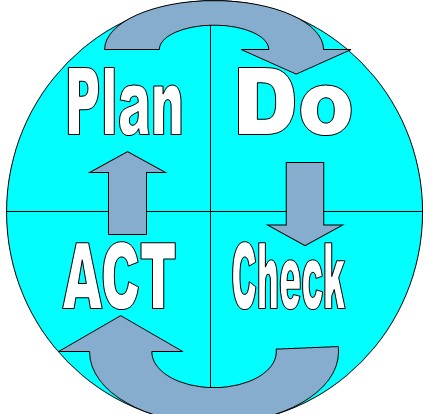
Plan-Do-Check-Act (Shewar cycle).
It’s an EMERGENCY! Ain’t no time to plan and check at 65 jobs an hour! (Slow is Smooth and Smooth is fast)
Study and Execute the Shewar cycle. Spin the rolodex. Find the training exercise or use-case that closely resembles your current crisis. Make a PLAN, then DO the plan, adjusting along the way. CHECK the results as you go. Shoot the engineer and ACT on the data collected. Did you kill it? Is it sort-of fixed or REALLY fixed? Guess what? Start again if you have to. That’s why it’s the Shewar cycle.
There are whole books written on PDCA, what it means, how to extend it. This is enough for here. Big Idea: You ALWAYS have time for PDCA. You should make a study of this.
OODA Loop: Observe – Orient – Decide- Act
Col. John Boyd was a fighter pilot. He defined the OODA loop. How do you react to a threat (someone literally trying to kill you) or solve an emergency?
- Observe: Take a breath. Understand the threat environment, to the extent allowed by time. What is the REAL crisis? What is short term vs. long term threat?
- Orient: Where are you? Where are others in the battle space?
- Decide: What is the best tactic then strategy to contain then solve the issue?
- Act: Do it! Make adjustments as necessary.
OODA requires that you start with some situational awareness OR that you develop situational awareness on-the-fly based on your experience as a problem solver.
Google “Pulp Fiction’s The Wolf Leadership Clip”. I won’t link it here, my oh my, such language!
If I’m curt with you it’s because time is a factor. I think fast, I talk fast and I need you guys to act fast if you wanna get out of this. (Winston Wolf / Pulp Fiction)
Detach / Cover & Move / Keep it Simple and Prioritize and Execute
Have I mentioned that I’m a fan of Jocko Willink? His latest book is “Leadership Strategy and Tactics”
Detach
Detachment is one of the most powerful tools a leader can have….be aware…when a situation is becoming chaotic…..physically take a step back….. are you raising your voice? Are you breathing hard?
Leadership Strategy and Tactics / Willink / Page 13-19.
Detachment is always a good thing, but in my career, I’ve been critiqued for being too detached. Show some passion! In some environments, not being a screamer and a table pounder can be interpreted as not caring.
I have a dad voice. I could get it out for a walk if need be. My advice: Save it for special occasions (very rare)
Cover and Move
Cover and Move requires teamwork. In the car business we called it containment. Make things safe, make sure the suppliers, operators in the plant and customers are safe. Make sure that you are not producing or shipping or receiving bad product. Protect production so you can buy some time to execute a ‘final’ solution. It could be that the team is split to multiply effort between containment and solution? It could be that the whole team covers (contains) and then moves to solution.
Keep it Simple, Prioritize and Execute
Keep it simple. You can become paralyzed with too many details. If you try to accomplish too many things, you accomplish nothing.
How many quotes are there? Perfect is the enemy of the good (Voltaire), Principle of the Golden Mean (Aristotle), Pareto Principle (Pareto).
“Go on and use the third best, the second best comes to late and the best never comes” (Robert Watson-Watt).
Prioritize and Execute is the Pareto Principle which can be anathema to a ‘real’ engineer who wants to achieve the most elegant and permanent solution. Prioritize and Execute says put out the fires, get the problem(s) contained, then go start the Shewar cycle to get rid of the patches, the extra inspections, the premium tolerances and materials.
Go use your DFSS Black Belt and get to the elegant solution that minimizes variation (first) and then eliminates the wasted energy (electrical / mechanical / thermal) that caused the problem in the first place.
I hate fire fighting. It means that I’ve failed to prevent a problem. I miss fire fighting. I LOVE to fix things and I can show off all the tricks of the trade and deep knowledge of case law I’d accumulated in my time in the car bidness.. Anyway, if the quarantine keeps up, I’ll write more about fire fighting vs. problem prevention.
 Don Wright's Chataqua
One thought on “#1: Slow is Smooth & Smooth is Fast”