What will you do with the data?
Dr. Deming: Any decision that management makes, that anybody makes for himself or for other people, is prediction. The simplest plan is prediction, with a chance to be wrong. I make plans. Those plans are predictions. Management is prediction; our lives are prediction. We predict what will happen. We try to choose a course of action that will react in favor of us. That’s our aim. We predict the consequence of actions
Deming Interview/ Industry Week Magazine / 17JAN84
NOTE: This came from chats with people from 2 different car companies!
Them: How’s retirement?
OD: Retirement is easy. Must be pretty boring for you with all the labs and plants shutdown…
Them: It busy and crazy and frustrating
OD: But how?
Them: Leadership is making up work that isn’t there. We don’t know when we will start again, we don’t have suppliers on line to talk to, but we are being asked for cost reduction plans and timing estimates, when we deliver, we are told that it’s not good enough, we need to sharpen the pencil, be more precise and more efficient!
OD: Don’t they know about the Pareto Principle? Occam’s Razor? How many validation engineers can dance on the head of a pin? What will they do with the data?
Occam’s Razor: The idea is attributed to English Franciscan friar William of Ockham (c. 1287–1347), who used a preference for simplicity to defend the idea of divine miracles. It is sometimes paraphrased by a statement like “the simplest solution is most likely the right one”. Occam’s razor says that when presented with competing hypotheses that make the same predictions, one should select the solution with the fewest assumptions,
Pareto Principle: Also known as the 80/20 rule, the law of the vital few, or the principle of factor sparsity. For many events, roughly 80% of the effects come from 20% of the cause. Note: In epidemics, some cases of super-spreading conform to the 20/80 rule, where approximately 20% of infected individuals are responsible for 80% of transmissions. Stay Home…
How many angels can dance on the head of a pin? is a reductio ad absurdum … In modern usage, the term is used as a metaphor for wasting time, for questions whose answers hold no intellectual consequence, while more urgent concerns accumulate.
Wikipedia / 27APR20
6 Decimal Places – Lesson from 4th Grade
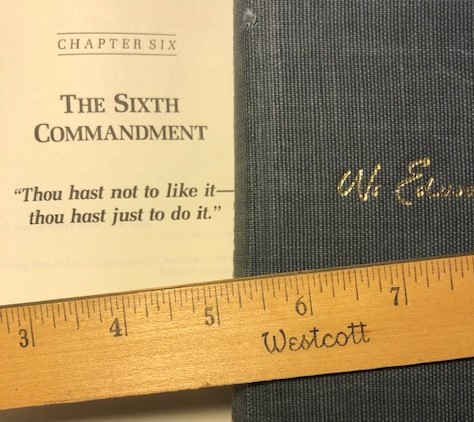
I wanted to be more-gooder. I was 9? Maybe 8. I had a wooden ruler with a metal edge and a stinky blue printed ditto (hot off the press) with a printed parallelogram. I measured A. I measured B. I calculated C. I calculated C to 6 decimal places. More-Gooder right? I got rapped on the knuckles, maybe literally, there was a metal edged wooden ruler right there!
- First lesson is precision. (Precision is the quality, condition, or fact of being exact). I had a wooden ruler marked in 1/16th of an inch. Not capable.
- Second lesson is ethics. Communicating an answer to 6 decimal places implied that I had useful information that I did not have. That level of precision wasn’t available based on the measurement tools used.
- Third lesson is waste. I spent pre-calculator time converting fractions and computing too many significant digits. Not only was it imprecise and deceptive, the worst sin was being wasteful of time, pencil lead and red rubber erasers.
What will you do with the data?
In the days before Design Review Based on Failure Mode (DRBFM) we would run tests pro forma. Just Because. You are s’posed ‘ta. Checking the boxes.
I had a great boss who would ask a frustrating question: What will you do with the data? What change could the data drive? Why can’t you get 80% of the answer with an analytical study? After you do ALL THIS WORK, What will you do? What decision are you making? (Accept / Reject, Characterization or input for math models, Ranking Good-Better-Best?)
My Advice: Ask the Boss….
“What are you going to do with this data?.. Do you know that the inputs that I have are sketchy and variable and that the spreadsheet you are asking for has way to much detail based on what we can know or predict? Do you know that the work to find the inputs will take my team off line for a week? I need to tell ny team WHY we need to do this push-up*, and What’s In It For / From Them?
*A push-up is snarky shorthand for an assignment that seems like “drop and give me 20 good ones” (football practice punishment). If you are doing pushups or any activity with no direct outcome, and it’s for training, that’s good. Big fan of training and activities to sharpen up / be better. Leaders should be wary and ashamed of transmitting push-up assignments, regardless of which executive is asking.
My advice may be flawed; Check local listings….It’s easy for me to say. I’m retired. I have no career on the line. My bonus is NOT based on a forced ranking that makes your boss choose the top 5%. Hell I don’t even have a bonus. I had the same job the last 20 years that I worked and there may be more than one reason for that. I did get to help lead and untangle processes (a good sign) but was in some ways a ‘challenging employee’.
I was not afraid to ‘coach-up’ or give advice up the leadership chain to my boss or his peers. Good leaders welcomed that I was giving advice based on experience and understood that I could (and would) follow ethical and legal direction when told to sit down and shut-up. Marcinko Rule 6.
If you ARE the Boss
Recognize that most good estimates (needed to provide directionality or good-better-best) can be done with simple methods.
- Make sure that YOU understand and can explain to your team, the purpose of data that you are gathering from your team. “If we do a good job explaining X, it will lead to more resources, recognition of problems that wee need help with….”
- Provide commander’s intent and expect feedback from your team about how to do it better.
- Don’t give in to the engineer’s temptation to go after precision that isn’t there. Don’t be part of the problem. Don’t ask or answer questions that are “order of magnitude” with 6 decimal places computation.
- Don’t imply that you know more than you do. Your great leader will know that you are stuck in 4th grade, trying to be more-gooder.
Do you want to BE good or LOOK good?
Sometimes you can’t do both. Be BRAVE! Fortitude!
 Don Wright's Chataqua