I did a class for a little company in Toledo on Problem Solving, 5 Why.
What I learned: Why is a powerful tool for root cause analysis. Why is a hard-ass question. It’s accusatory to most Americans. How can I do better / not lose 5 Why power while acculturating to the purpose?
Root Cause means Take it to the end. Branch. Cross functions and levels of the product / process and organization. You many not finish, you may create new projects that are driven by the original occurrence but support having to NEVER fix the same occurrence again.
The end of Root Cause Analysis has to be PREVENTION. We’ve gone DEEP and WIDE.
After we root cause the issue, we don’t solve the occurrence, we have prevented the problem through irreversible corrective action throughout the company and processes and procedures and product lines.
A brilliant engineer and communicator taught me about writing to the 8th grade reading level.
A podcast rabbit-hole that I travel to is “The Learning Leader” hosted by Ryan Hawk. Ryan advocates that learning to write is a good way to learn to think. (See Blog #5 If you Write It: Learning the Way of the Carney)
One takeaway is to write as though you were writing to a person sitting across from you.
Connecting those dots: Because I’m an advocate of the 8th grade reading level, I must think you are dumb, kind of slow, right? Eighth grade reading level shouldn’t apply to high end leadership and quality coaching and teaching, right? What must I think of you? Sharp as a bag of hammers, am I right? Nope.
Here’s what I think:
You are busy and don’t have patience for high art (in this context anyway).
You have distractions that may break your flow
You MAY be operating in English as your second language (EASL). My mentor (Clark) had the benefit of a wife who was a language teacher and appreciated writing to an audience who may be operating in a second language.
You need to read, understand and act on what you have read, and if I’m serious about my message, it had better be easy to follow and easy for you to act upon.
Did you Know:
In MS Word you can check the Flesch-Kincaid Grade Level of your document? There’s another measure called the Gunning Fog Index which does the same thing, checks your writing for complexity and projects into a ‘grade level’ for readers. Gunning Fog Index (gunning-fog-index.com)
What brought this to mind?
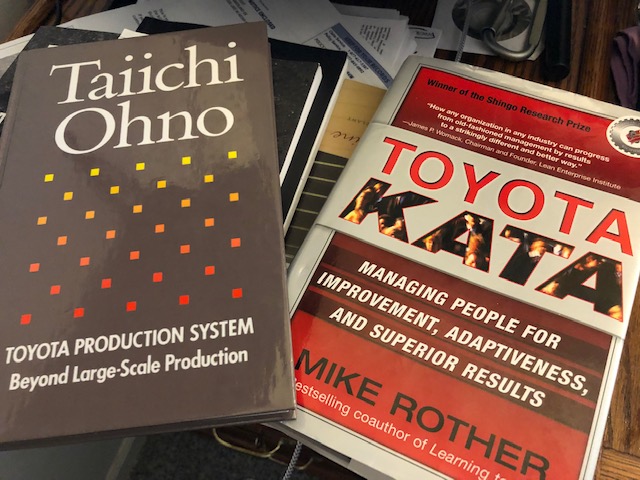
I’m reading some great books about the Toyota Production System (TPS). I started in November with Toyota Kata by Mike Rother, which is written directly, simply and with a cadence that sounded like it was translated from the Japanese. It was not. I then read Toyota Production System by Taiichi Ohno, written with short declarative sentences and punctuated with Socratic questions that were then answered in the next line or paragraph.
It was reminiscent of Tatsuhiko Yoshimura’s writings that were translated for us at GM. Yoshimura san’s technical assistants were born in Japan, educated both there and in the US and translated in the style that I’m reading from Mr. Rother and from the Ohno book. One of my Audible books is The Book of Five Rings (Musashi) which is again, a translation from Japanese. The cadence is there too. I even looked up Iambic Pentameter, which this is not. Maybe it’s lean octameter?
Technical Writing / Writing for Instruction:
In teams I was in and teams that I led; we wrote many technical documents like:
Specifications
What should the product be and what should the product do?
Procedures
How do you perform a task? Procedures are written to a standard format and flow for the purpose of communicating to labs, suppliers, technicians, other engineers.
Reports
Results of evaluations (which were hopefully performed to a procedure or according to a specification) are documented in ‘Evaluation Reports’
Service Bulletins
Written to a fixed and familiar outline using the minimum of conditional words and maximizing the use objective descriptions. Note: The service bulletin form and guidance are a good way to communicate problems and solutions using an outline or form of CONDITION / CAUSE / CORRECTION.
Experiences:
My first big publication (after the bachelor’s thesis) was as a collaborator on an SAE paper. I wrote the first draft and outline, pretty close to a service bulletin style, simple, declarative. My co-authors tore it up, made hash of it (in my opinion). Not ‘professional’ enough. By the time it was ready for press, it had lots of big words and high sounding third person assertions. (SAE 861029, Integrated Vehicle Systems Diagnostics – Powertrain & Chassis (Co-Author presented to IEEE / SAE Convergence))
My career from 1984 through about 1991 was as a technical writer in the Cadillac service community. Back to condition / cause / correction, simple declarative, unambiguous (don’t say fully driven / seated and not stripped, instead say, finger start then torque to 7 Nm)
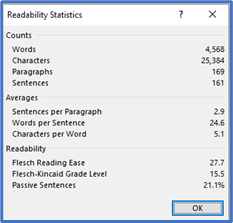
My latest adventure has been as an expert witness / consulting engineer for law firm. I wrote a report for said adventure and the first draft was a failure. I needed to be more lawyerly. After iteration, the result is Grade 15 reading level, 25 words in a sentence. Not very Zen or quality like. Very legalistic.
One of my favorite comedians (the great and powerful Doug Stanhope) teaches us (in his own way) about using big words to show off. Doug is known to respond to a haughty statement full of 10-dollar words with “What, have you been reading smart-F$%* magazine again?” His way of correcting an annoying behavior is with sarcasm and shaming. That’s how I grew up, so I understand it. Don’t make it a go-to. It isn’t endearing and only pays off for crowd work comedians.
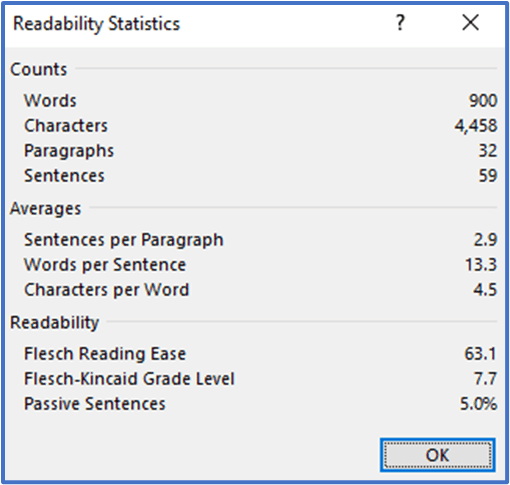
Anyway, here is the reading index for this piece: 7.7 GRADE LEVEL!
Wheel / Snipe and Celly! I made it look easy.
PS:
I did have to look up Iambic Pentameter. Is that what quality book cadence is? Nope.
Iambic Pentameter is from poetry, the pentameter (Penta meter) is five beats (they call it five ‘feet’). The iamb is a two-syllable word, with second syllable stressed. The Wiki example is “TwoHouseholds, BothAlike In Dignity”. I reckon there are five beats there and 2 of the 5 are two syllables. I’m not feeling the second syllable stressed gimmick. I give up.
Host Ryan Hawk has some killer guests. Maybe he spends too much time selling his stuff / not enough time curating? Anyway: I accidently listened to this one with David Perell which is near and dear to me because,
Early this year, I committed to writing down some of the voices that I hear and take to heart, and,
I have failed at doing so for months. That’s why this episode gave my discipline monitor a good spanking.
David Perell says you should write to get better at writing and you should publish to see if people like it. He also said that people who like your writing will come to your soapbox and listen. If they REALLY like your writing, they will tell others and share and next thing you know, you have a community.
Here’s the dirty part: If you grow a community, you could end up building things (ideas) to sell to them.
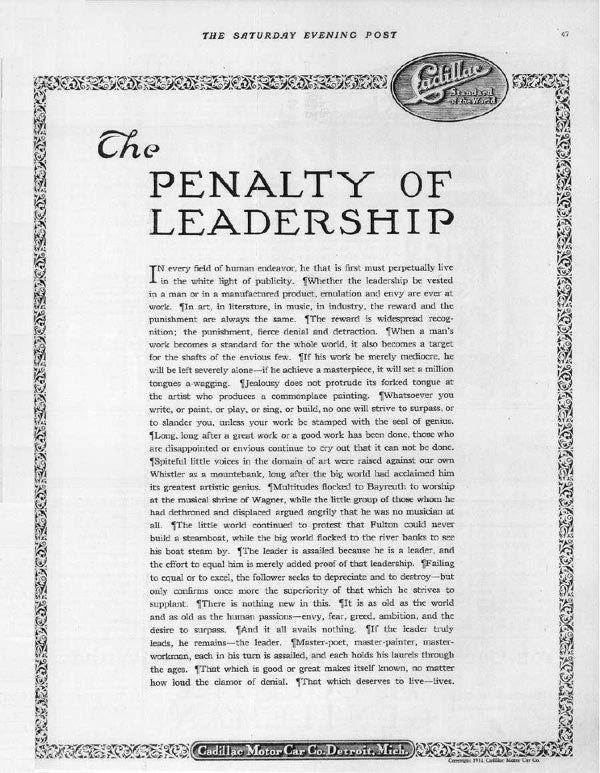
If you write it, they will come! “The little world continued to protest that Fulton could never build a steamboat, while the big world flocked to the river banks to see his boat steam by.” (From the 1915 Ad for Cadillac, “Penalty of Leadership”)
The intro to Gallagher’s Sledge-O-Matic bit parodies a carney speech (building the tip): “I have not come here to entertain you, I’ve come here to sell you something!” Rabbit Hole: How do Carney’s work? This is good for you to know so you can protect yourself against Disney, Cruise Lines, QVC and Timeshare sales.
If you know the way, you will see the way in all things.
Building and Freezing a Tip: “You’ve assembled a gaggle of freeloaders, but they’re not a “tip” until they’re paying close and continued attention. “Freezing the tip” is getting them almost immobilized … get them to move closer to see better, making it difficult for anyone to leave because of the tightly-packed crowd. Ward Hall told the Sideshow Central website that “You need to freeze the tip while the talker makes the pitch. The things that work best: daytime, a beautiful girl in a revealing costume holding a big fat snake. At night: fire eating with a fire blast, fire juggling, or even better, a strong freak.””
What sucks for me: Publishing. Why? Low self esteem? Imposter Syndrome? Why do you care what I think? What if you don’t like it? What If I spell something wrong? I want oxytocin not cortisol!
So, I’m making another run at publishing on the blog as a routine and building one ASQ talk per year. Some of the writing is codifying things I’ve thought and coached. Some is curation (like book reviews). If I read a good book with another way to think about things, I share. If I read a garbage book, I quietly donate it and move along.
Meanwhile, check out the Learning Leader and the ep with David Perell. And study the way of the Carney. Be safe, enjoy life, write stuff and be fearless.
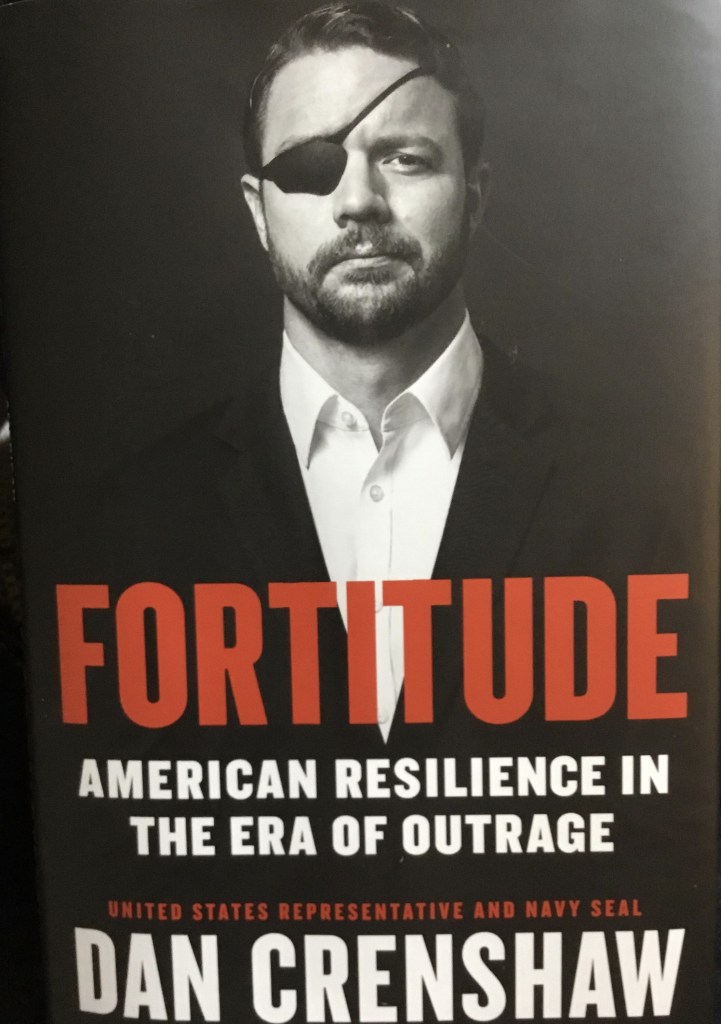
All of the above. Dan Crenshaw is a Navy Seal, blown up by an IED, ran for Congress and won, made light of by Saturday Night Live and came back (not with outrage) but with good humor of his own. Now he has a podcast AND this book. He seems to be a lightning rod. Too conservative. Not Trumpy enough. It may be that he listens and takes pretty common sense, actionable policy positions. Such positions don’t satisfy outrage from either side.
Why Did I buy it?
I’ve heard Mr. Crenshaw on the Jocko podcast twice and now I listen to his podcast (from his congressional office).
BIO: Small bio, enough to show where Mr. Crenshaw came from.
Leadership: A little. One thing I need to talk about (sometime) is that a key element of leadership is leading yourself.
Self Improvement: I think the centroid of the book is leading yourself (How To). Is it 12 Rules for Life-lite? A little bit. It’s about how to lead / manage yourself (with a perspective of leading others).
Key Points / Chapters:
Have Hero’s: Aspire. Have aspirational / inspirational people to follow / emulate
No Plan B: He talks about failure (in his life, not admitted to Naval Academy or Rice University, rolled back in BUD/S, his mom died of cancer). Talks about having contingency plans on the path to a goal, but talks about not having a ‘Plan B” in the back of your mind ad you execute toward your goal.
Be Still: Is more of the Jocko / Detach, the OODA loop, see blog post “Slow is Smooth..”
Sweat the Small Stuff: Attention to detail / preparation.
Shame: Internalized shame or fear of failure. Use your oxytocin
Duty: Sense of Duty Self / Family / Society
Do Something Hard: Self imposed challenges.
Stories We Tell Ourselves: My reading is that you should tell yourself the truth, not make excuses, be honest about what you did well and what you did poorly.
Is it worth the read?
Yup. I’m a little jaded because I’ve been rabbit-holing 12 Rules, Jocko books, Leadership Secrets, Simon Sinek….. BIG IDEA: This is a good read, to get perspective on self-leadership, learn to deal with setbacks and go forward. No Plan B.
Dr. Deming: Any decision that management makes, that anybody makes for himself or for other people, is prediction. The simplest plan is prediction, with a chance to be wrong. I make plans. Those plans are predictions. Management is prediction; our lives are prediction. We predict what will happen. We try to choose a course of action that will react in favor of us. That’s our aim. We predict the consequence of actions
Deming Interview/ Industry Week Magazine / 17JAN84
NOTE: This came from chats with people from 2 different car companies!
Them: How’s retirement?
OD: Retirement is easy. Must be pretty boring for you with all the labs and plants shutdown…
Them: It busy and crazy and frustrating
OD: But how?
Them: Leadership is making up work that isn’t there. We don’t know when we will start again, we don’t have suppliers on line to talk to, but we are being asked for cost reduction plans and timing estimates, when we deliver, we are told that it’s not good enough, we need to sharpen the pencil, be more precise and more efficient!
OD: Don’t they know about the Pareto Principle? Occam’s Razor? How many validation engineers can dance on the head of a pin? What will they do with the data?
Occam’s Razor: The idea is attributed to English Franciscan friar William of Ockham (c. 1287–1347), who used a preference for simplicity to defend the idea of divine miracles. It is sometimes paraphrased by a statement like “the simplest solution is most likely the right one”. Occam’s razor says that when presented with competing hypotheses that make the same predictions, one should select the solution with the fewest assumptions,
Pareto Principle: Also known as the 80/20 rule, the law of the vital few, or the principle of factor sparsity. For many events, roughly 80% of the effects come from 20% of the cause. Note: In epidemics, some cases of super-spreading conform to the 20/80 rule, where approximately 20% of infected individuals are responsible for 80% of transmissions. Stay Home…
How many angels can dance on the head of a pin? is a reductio ad absurdum … In modern usage, the term is used as a metaphor for wasting time, for questions whose answers hold no intellectual consequence, while more urgent concerns accumulate.
Wikipedia / 27APR20
6 Decimal Places – Lesson from 4th Grade
I wanted to be more-gooder. I was 9? Maybe 8. I had a wooden ruler with a metal edge and a stinky blue printed ditto (hot off the press) with a printed parallelogram. I measured A. I measured B. I calculated C. I calculated C to 6 decimal places. More-Gooder right? I got rapped on the knuckles, maybe literally, there was a metal edged wooden ruler right there!
First lesson is precision. (Precision is the quality, condition, or fact of being exact). I had a wooden ruler marked in 1/16th of an inch. Not capable.
Second lesson is ethics. Communicating an answer to 6 decimal places implied that I had useful information that I did not have. That level of precision wasn’t available based on the measurement tools used.
Third lesson is waste. I spent pre-calculator time converting fractions and computing too many significant digits. Not only was it imprecise and deceptive, the worst sin was being wasteful of time, pencil lead and red rubber erasers.
What will you do with the data?
In the days before Design Review Based on Failure Mode (DRBFM) we would run tests pro forma. Just Because. You are s’posed ‘ta. Checking the boxes.
I had a great boss who would ask a frustrating question: What will you do with the data? What change could the data drive? Why can’t you get 80% of the answer with an analytical study? After you do ALL THIS WORK, What will you do? What decision are you making? (Accept / Reject, Characterization or input for math models, Ranking Good-Better-Best?)
My Advice: Ask the Boss….
“What are you going to do with this data?.. Do you know that the inputs that I have are sketchy and variable and that the spreadsheet you are asking for has way to much detail based on what we can know or predict? Do you know that the work to find the inputs will take my team off line for a week? I need to tell ny team WHY we need to do this push-up*, and What’s In It For / From Them?
*A push-up is snarky shorthand for an assignment that seems like “drop and give me 20 good ones” (football practice punishment). If you are doing pushups or any activity with no direct outcome, and it’s for training, that’s good. Big fan of training and activities to sharpen up / be better. Leaders should be wary and ashamed of transmitting push-up assignments, regardless of which executive is asking.
My advice may be flawed; Check local listings….It’s easy for me to say. I’m retired. I have no career on the line. My bonus is NOT based on a forced ranking that makes your boss choose the top 5%. Hell I don’t even have a bonus. I had the same job the last 20 years that I worked and there may be more than one reason for that. I did get to help lead and untangle processes (a good sign) but was in some ways a ‘challenging employee’.
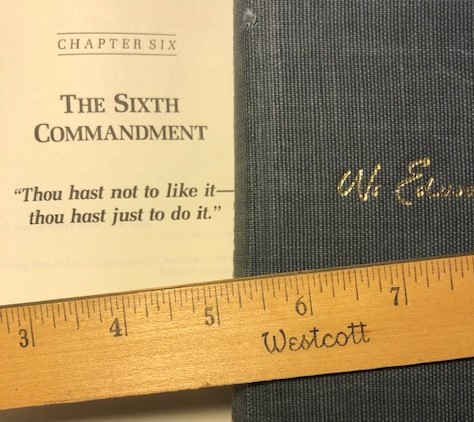
I was not afraid to ‘coach-up’ or give advice up the leadership chain to my boss or his peers. Good leaders welcomed that I was giving advice based on experience and understood that I could (and would) follow ethical and legal direction when told to sit down and shut-up. Marcinko Rule 6.
If you ARE the Boss
Recognize that most good estimates (needed to provide directionality or good-better-best) can be done with simple methods.
Make sure that YOU understand and can explain to your team, the purpose of data that you are gathering from your team. “If we do a good job explaining X, it will lead to more resources, recognition of problems that wee need help with….”
Provide commander’s intent and expect feedback from your team about how to do it better.
Don’t give in to the engineer’s temptation to go after precision that isn’t there. Don’t be part of the problem. Don’t ask or answer questions that are “order of magnitude” with 6 decimal places computation.
Don’t imply that you know more than you do. Your great leader will know that you are stuck in 4th grade, trying to be more-gooder.
The world of Validation is made up of PREVENT-DETECT-CORRECT. The high calling is Prevent. If you do a good job of Prevent with a minimum of last minute shoe-string catches (Correct) then you will Make it Look Easy.
When you Make it Look Easy:
You bring results with a minimum of exceptions to meeting requirements. You bring data which you don’t have to explain. You have time to talk about finesse and continuous improvement and how to make things even better. You are accomplishing incredibly difficult things with seeming ease. Sully Sullenberger. Joe Montana. Anton Chigurh. Ayerton Senna in the rain.
So, the Exhortation: When I tell a team mate “Make it Look Easy”, I’m sending him or her off with commanders’ intent to accomplish a long complex series of tasks, dependent on a matrix team, including people who are senior in years and experience to them, at labs, tier 1 suppliers and in the internal engineering team.
A Parable
Imagine you are invited to a meeting to show status to a Chief Engineer. Two teams (A and B) are scheduled into the same time slot, each is to show progress and risk.
Team A brings 8 people and reams of PowerPoint slides. Their story is long and sad, lots of late items, items that require deviation to standard, recovery plans and risk items. They get invited to a follow up meeting / beating.
Team B sends one guy. (1) Team B reports all is on time, except for one item that finishes on the day of the deadline; a small amount of meeting time is spent describing the one close-to-deadline item and how it is being managed. Since there is plenty of meeting time left, the Team B guy talks through what is being done to make sure it will never happen again. Team B made it look easy! (2)
The Team B manager tags along to catch random incoming from Chief Engineers (who sometimes need to show the size of their “personality”). PS: It could be Team B Guy or Gal, the person who did the work and therefore needs the exposure and credit.
Was it easy? Nope. Cal Ripken turning a double. Ted Williams stroking one out. Patrick Mahomes dropping it into a moving basket from 40 yards away. Insert cliché here for a person or team that worked hard to develop their craft, strategy, contingencies. It was Training, preparation, relationship building, teamwork and Prevention.
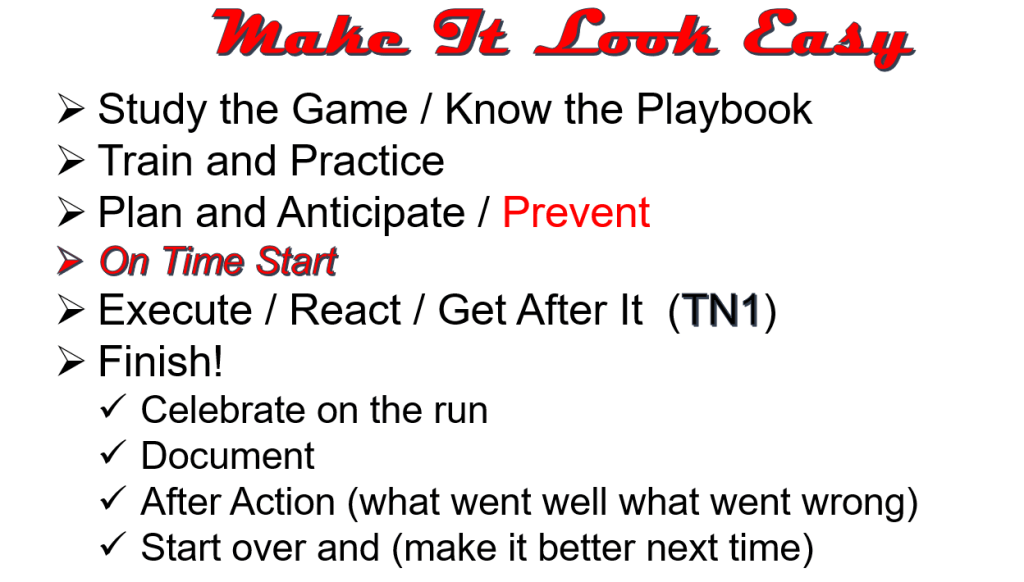
Make it Look Easy: Bullets
Study the Game / Know the Playbook / Train and Practice
Deming:Institute Training on the Job. Training never stops. Training isn’t just sitting through webinars or live lectures. Training includes practice. Training includes case studies or exercise. Training makes you ready to execute and more ready to course correct. Training requires a buddy system; new guy needs a ‘swim buddy’. A great team has strengths that are distributed. A great team helps each other by complementing weaker areas.
The first step is transformation of the individual. This transformation is discontinuous. It comes from understanding of the system of profound knowledge. The individual, transformed, will perceive new meaning to his life, to events, to numbers, to interactions between people.”
Once the individual understands the system of profound knowledge, he will apply its principles in every kind of relationship with other people.
Deming / The New Economics
Practice makes perfect, or rather “Perfect Practice Makes Perfect” (Lombardi).
I shall punish thy bodies because the more thou sweatest in training, the less thou bleedest in combat. (Marcinko)
Plan-Anticipate-Prevent
No battle plan survives contact with the enemy
Helmuth von Moltke the Elder, Chief of Staff, Prussian army, World War 1
So, there is always a plan, it is usually from a template, your job is to modify the plan to be efficient, to conform to reality of time and budget (resources) and to allow recovery from Adversity.
You need to Anticipate what can go wrong based on risk. Risk can arise from technical difficulty, logistics, relationships, past experience with a supplier or a manufacturing location. Anticipation means that you know what to do / how to react when the plan goes off course. Jocko Willink calls it “Preemptive Ownership” (Leadership Strategy and Tactics, 1st Ed., P 103.)
Prevent is continuous. Anticipate is followed by prevention. What is supposed to happen next week? Are we Ready? Have we talked through what can go wrong with the next activity? Do we have backup? It won’t look easy if we have to scramble every day. Be a point guard in basketball. Be a catcher in baseball. Stay ahead of the play, what is the opposition going to do, how can we counter it?
On Time Start
Easy. Don’t monitor event finish times, obsessively protect starts. What is starting this week? Are we ready? Do we have tools / parts / equipment / requirements / technicians / lab space? Can I come see while we have time to recover missing parts of the plan?
Execute / React / Get After It (TN1)
Execute means, you’ve prepared, checked, double checked, been to visit, saw the start and NOW have to keep your eye on the ball as the play moves ahead.
React means that you are able to solve issues on the fly and keep the plan on track.
Get After it / TN1 is you being patiently aggressive, projecting the urgency of not letting things slip.
We used to talk of a ‘call tree‘ which means: Test Stand Stops at 11PM on Superbowl Sunday. Who knows? Who will they call at the lab? Who will the lab call at the Tier 1? Who at the Tier 1 will call the OE? What is the OE plan? Validation Calls Release, Leadership is Notified of new risk, parts and solutions are carried forward, test restarts the next morning?
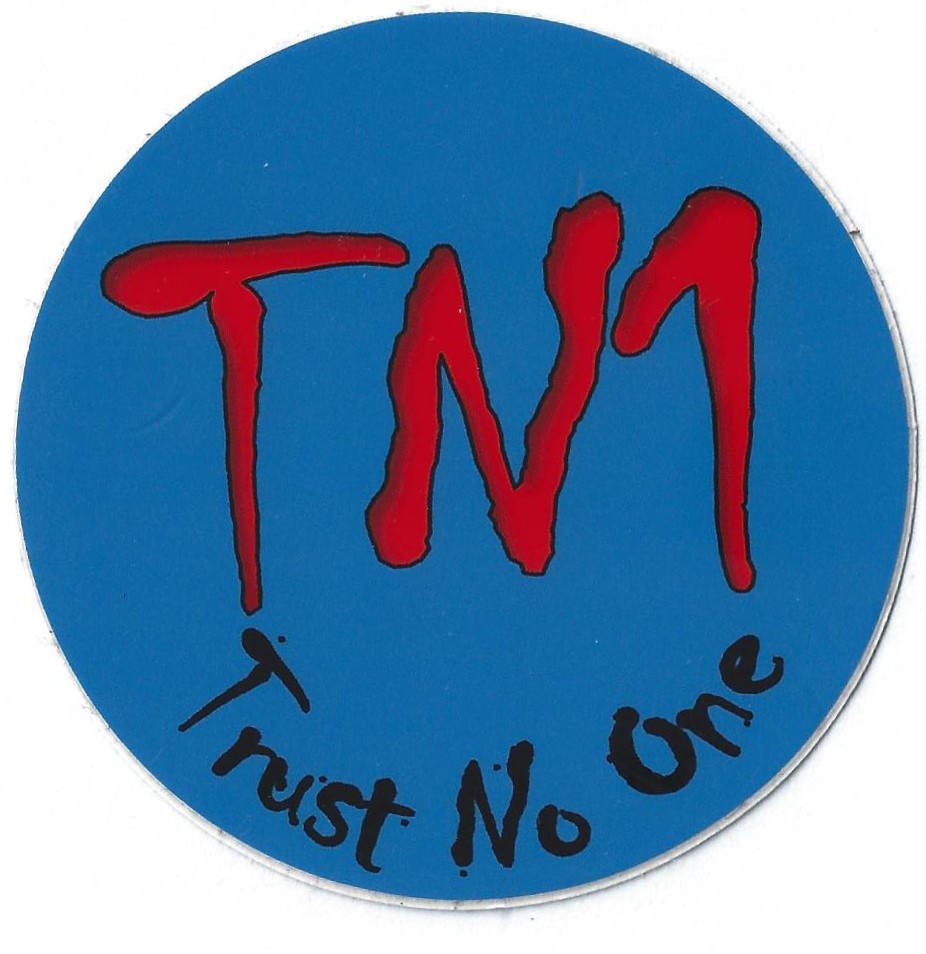
Note about TN1: TN1 (Trust No-One) seems very anti-team, anti-collaboration and (by definition) anti trust. TN1 is a meme that says, make sure you are on point with data, that all are comfortable with. The Tier 1 is comfortable with requirements and timing, the OE has excellent line of site and communication about progress, timing and results.
Finish
Celebrate
On-time with Excellence is a good feeling, it’s a win. Don’t forget to give credit, take credit and celebrate the team. Celebrate on the run means that the next battle is coming. There is no rest. The easy day was yesterday.
Document
Report the results, could be pro-forma reports for archive, could be reports of results for regulations / compliance.
After Action
Stop, take a breath and document: All of the reaction / recovery / actions need to be reconciled. Why did they happen? What could have been done to make it look easie(r)?
Start Over
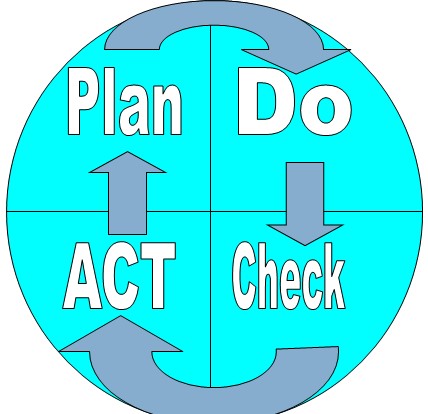
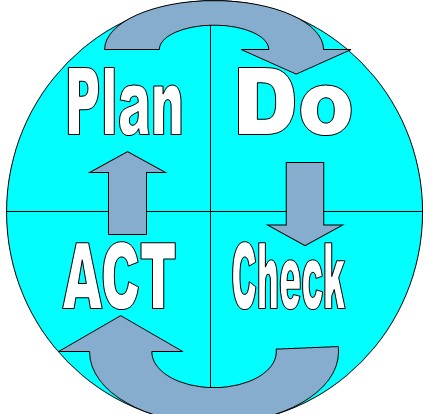
PDCA. IDDOV. DMAIC. All of the acronyms say, start over, from a better place than before, and Make it Look Easy (again).
PDCA
Feedback Needed: How did I do?
Not sure if this hit the mark? If I slapped you on the shoulder and sent you on a mission and said “Make it Look Easy?”, would you know what I meant? Would you know how to act?
“10: Eliminate slogans and exhortations for the work force asking for zero defects and new levels of productivity. Such exhortations only create adversarial relationships, as the bulk of the causes of low quality and low productivity belong to the system and thus lie beyond the power of the work force.”
Deming / Out of the Crisis / Chap 2 / Principles for Transformation
Is it sloganeering or a Meme? What’s a Meme?
I have all kinds of bumper sticker wisdom that I would share with the team. There was always creeping guilt that I was perpetrating an Exhortation. If you are counter-Deming, you are off the path. It made my life hard at work, because the floors and walls were littered with things that Deming would think silly. Having Deming awareness can be a tough way to go through life.
I started calling my bumper sticker wisdom a Meme. A meme isn’t a snarky internet post of N-Po eating ice cream. Meme has a definition and is being proposed as something that can enter your genetics…. Slow down Richard Dawkins.
“The word meme is a neologism coined by Richard Dawkins.[11] It originated from Dawkins’s 1976 book The Selfish Gene. A meme acts as a unit for carrying cultural ideas, symbols, or practices, that can be transmitted from one mind to another through writing, speech, gestures, rituals, or other imitable phenomena with a mimicked theme.”
Wikipedia
Our team Meme’s were intended as symbols, short hand. One line or a symbol could help re-center the conversation and nudge people back on the path (at least among the initiated). “If you know the way, you see the way in all things”. A meme is a prison joke.
New guy goes to prison, stressful first day, his cell mate, just after lights out, leans out the door and yells “FIFTY THREE” and the whole tier breaks out in laughter. New guy says, “what just happened?” Cell mate says, “We all know all of the same jokes, so we save time by just yelling out the number, everybody thinks of it and laughs”. New guy says, “can I try?” Cell mate says “sure, 28 is sure fire. Always kills” New guy works up his courage, leans out of the cell and yells “Twenty Eight!” Silence. New guy asks “What went wrong?” Cell mate says “It’s how you told it.”
Street Joke
Frequently Occurring Memes
Granny used to say……
“The Road to Hell is Paved with Good Intentions“…. It’s a longer way of saying that someone needs to get a round-TUIT. My intent of this post was originally to explain “Make it Look Easy”. This may turn into a series of ‘what’s behind the meme’. Each of these memes has an etymology and origin story. I’ll get there! Next post?
“Everyone has a plan until they get punched in the mouth” (M. Tyson)
The right answer is ALWAYS P-D-C-A
Punched in the Mouth is a metaphor. I worked 41 years for a car company (the one with the blue and white logo, the more square one not the oval one with cursive writing) and I never was physically punched in the mouth or anywhere else. There were many unforeseen turns of events that caused disruption, failure and near failure.
Here’s a big idea: Things seldom go according to plan. People and teams who perform well in their arena are usually GREAT at adapting to disruption. There is always disruption.
Why are some teams great at solving a crisis? Great Instincts? Yeah, but what does that really mean? Where does instinct and luck come from? I think it comes from training, preparation, contingency planning, knowledge of cases and case application. As Musashi says in The Book of Five Rings: “You should make a study of this”.
Techniques for Reacting to Crisis include:
PDCA
OODA
Detach / Cover and Move / Prioritize and Execute
Lift Vector On, and Pull: (Drive toward the threat)
Spin the rolodex (Review past cases and solutions for applicability)
I’m going to opine about PDCA, OODA then Detach / Cover and Move / Prioritize and Execute. More later, if the quarantine keeps going.
Plan-Do-Check-Act (Shewar cycle).
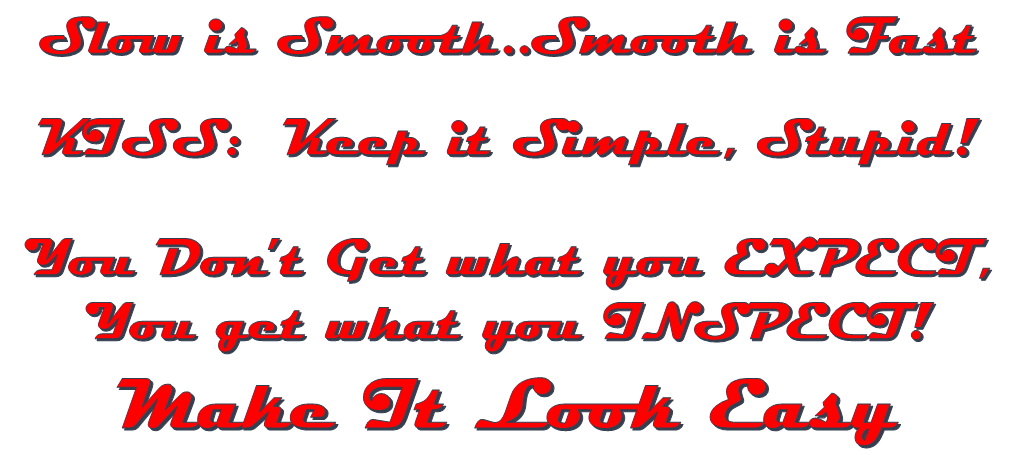
It’s an EMERGENCY! Ain’t no time to plan and check at 65 jobs an hour! (Slow is Smooth and Smooth is fast)
Study and Execute the Shewar cycle. Spin the rolodex. Find the training exercise or use-case that closely resembles your current crisis. Make a PLAN, then DO the plan, adjusting along the way. CHECK the results as you go. Shoot the engineer and ACT on the data collected. Did you kill it? Is it sort-of fixed or REALLY fixed? Guess what? Start again if you have to. That’s why it’s the Shewar cycle.
There are whole books written on PDCA, what it means, how to extend it. This is enough for here. Big Idea: You ALWAYS have time for PDCA. You should make a study of this.
Col. John Boyd was a fighter pilot. He defined the OODA loop. How do you react to a threat (someone literally trying to kill you) or solve an emergency?
Observe: Take a breath. Understand the threat environment, to the extent allowed by time. What is the REAL crisis? What is short term vs. long term threat?
Orient: Where are you? Where are others in the battle space?
Decide: What is the best tactic then strategy to contain then solve the issue?
Act: Do it! Make adjustments as necessary.
OODA requires that you start with some situational awareness OR that you develop situational awareness on-the-fly based on your experience as a problem solver.
Google “Pulp Fiction’s The Wolf Leadership Clip”. I won’t link it here, my oh my, such language!
If I’m curt with you it’s because time is a factor. I think fast, I talk fast and I need you guys to act fast if you wanna get out of this. (Winston Wolf / Pulp Fiction)
Detach / Cover & Move / Keep it Simple and Prioritize and Execute
Have I mentioned that I’m a fan of Jocko Willink? His latest book is “Leadership Strategy and Tactics”
Detach
Detachment is one of the most powerful tools a leader can have….be aware…when a situation is becoming chaotic…..physically take a step back….. are you raising your voice? Are you breathing hard?
Leadership Strategy and Tactics / Willink / Page 13-19.
Detachment is always a good thing, but in my career, I’ve been critiqued for being too detached. Show some passion! In some environments, not being a screamer and a table pounder can be interpreted as not caring.
I have a dad voice. I could get it out for a walk if need be. My advice: Save it for special occasions (very rare)
Cover and Move
Cover and Move requires teamwork. In the car business we called it containment. Make things safe, make sure the suppliers, operators in the plant and customers are safe. Make sure that you are not producing or shipping or receiving bad product. Protect production so you can buy some time to execute a ‘final’ solution. It could be that the team is split to multiply effort between containment and solution? It could be that the whole team covers (contains) and then moves to solution.
Keep it Simple, Prioritize and Execute
Keep it simple. You can become paralyzed with too many details. If you try to accomplish too many things, you accomplish nothing.
How many quotes are there? Perfect is the enemy of the good (Voltaire), Principle of the Golden Mean (Aristotle), Pareto Principle (Pareto).
“Go on and use the third best, the second best comes to late and the best never comes” (Robert Watson-Watt).
Prioritize and Execute is the Pareto Principle which can be anathema to a ‘real’ engineer who wants to achieve the most elegant and permanent solution. Prioritize and Execute says put out the fires, get the problem(s) contained, then go start the Shewar cycle to get rid of the patches, the extra inspections, the premium tolerances and materials.
Go use your DFSS Black Belt and get to the elegant solution that minimizes variation (first) and then eliminates the wasted energy (electrical / mechanical / thermal) that caused the problem in the first place.
I hate fire fighting. It means that I’ve failed to prevent a problem. I miss fire fighting. I LOVE to fix things and I can show off all the tricks of the trade and deep knowledge of case law I’d accumulated in my time in the car bidness.. Anyway, if the quarantine keeps up, I’ll write more about fire fighting vs. problem prevention.
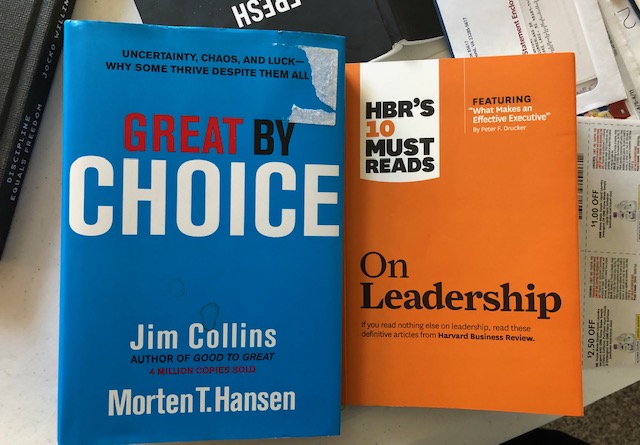
So, I’ve read many of the Jim Collins books, Good to Great, Great By Choice, Built to Last are (or were) on the shelf.
(Were on the shelf because I give books to ‘loan’, never get ’em back which hopefully means they are of value and doing good things for people in the world.
I heard an inspirational (and reportedly rare) podcast interview with Jim Collins and Tim Ferris. During the Tim Ferris Podcast, Jim Collins talks about John McPhee, a great writer and a great teacher of writing (see Uncommon Carriers and Draft #4) and Peter Drucker.
That started me down a rabbit hole. It’s a bad habit. Jim Collins talked about the fact that Drucker wrote more than half of his books after age 65, which is inspiring to a 60.7 year old.
THAT turned into a need for a particular Peter Drucker article which you can only find in a book called “On Leadership” from Harvard Business Review. (I do this so you won’t have to.)
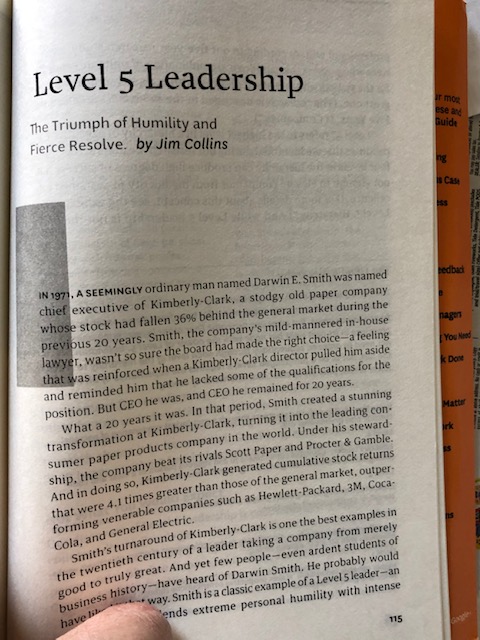
Lucky Me! The little orange book had a compact article called “Level 5 Leadership – The Triumph of Humility and Fierce Resolve” which brings me back to my now popular thesis: Servant Leadership is effective leadership.
According Collins and this article, a level 5 leader “Builds Enduring Greatness” through a combination “of personal humility plus professional will“
The TLDR (too long didn’t read) is that Collins is not a fan of the Jack Welch, Lee Iacocca ego leaders. A level 5 leader is all about building the company for the long haul (vs. a quick buck or flash for investors). A level 5 leader is a ‘Strategist’.
Big Ideas:
Great Companies are “Built to Last”
Level 5 Leaders are strategists (or alchemists) in it for the long haul.
Collins talks about a flywheel effect in which the company is slowly moved in direction based on strategy, and like a flywheel, it starts slow and builds momentum. (Deming talks about Constancy of Purpose, the first of the 14 points, Big Fan).
The Article from “On Leadership”
The “Level 5 Leadership” article talks about how to grow to level 5 leadership. It’s a short form of the many books and on point for this HBR book which is supposed to teach you to be a better leader. There’s a chunk “Growing to Level 5“
First Who: Attend to people first, strategy second. I’d like to think that Collins coined “Right People on the bus” as well as “right seat on the bus”. Some of my greatest and most powerful engineers were found in the wrong seat in the big blue square bus. NOTE: Some people that I lured onto the bus were NOT great fits to our team and had to leave the bus.
Stockdale Paradox: This one tickled me because Sensei Tatsuhiko Yoshimura used the Stockdale Paradox to teach us: Deal with reality / brutal truth and maintain faith that you will prevail.
Buildup-Breakthrough Flywheel: Keep pushing / build momentum (big-mo) until breakthrough.
The Hedgehog Concept: A) What can your company be best at? B) How do your economics work best? C) What ignites people’s passions (First Who). ELIMINATE EVERYTHING ELSE! (Constancy of Purpose)
That’s pretty much it. Read all of the Collins books. The Article in the orange book is good guidepost to grow your leadership style.
Caution: Servant / Level 5 Leadership MAY NOT be valued on some buses or bus companies. If the system at your company is full of short term metrics (at the expense of vision) and requires forced ranking of people, you may not be on the right bus: Your bus may be full of “The Big C” (Cortisol).
If you enter work and start to feel dread, anxiety and fear: Find a different organization to work in (or a different seat on the bus).
Don’t stick with a boss who is a cortisol monster (Deming says ‘Drive out Fear’). Cortisol is good when there is danger from outside / bad if you’re in a supposed circle of safety.
PS: I must be rich right? Always buying books? See the Link Below. Be patient, it ain’t Amazon but you get a book for $3 and $6 shipping.


 Don Wright's Chataqua