A brilliant engineer and communicator taught me about writing to the 8th grade reading level.
A podcast rabbit-hole that I travel to is “The Learning Leader” hosted by Ryan Hawk. Ryan advocates that learning to write is a good way to learn to think. (See Blog #5 If you Write It: Learning the Way of the Carney)
One takeaway is to write as though you were writing to a person sitting across from you.
Connecting those dots: Because I’m an advocate of the 8th grade reading level, I must think you are dumb, kind of slow, right? Eighth grade reading level shouldn’t apply to high end leadership and quality coaching and teaching, right? What must I think of you? Sharp as a bag of hammers, am I right? Nope.
Here’s what I think:
- You are busy and don’t have patience for high art (in this context anyway).
- You have distractions that may break your flow
- You MAY be operating in English as your second language (EASL). My mentor (Clark) had the benefit of a wife who was a language teacher and appreciated writing to an audience who may be operating in a second language.
- You need to read, understand and act on what you have read, and if I’m serious about my message, it had better be easy to follow and easy for you to act upon.
Did you Know:
In MS Word you can check the Flesch-Kincaid Grade Level of your document? There’s another measure called the Gunning Fog Index which does the same thing, checks your writing for complexity and projects into a ‘grade level’ for readers. Gunning Fog Index (gunning-fog-index.com)
What brought this to mind?
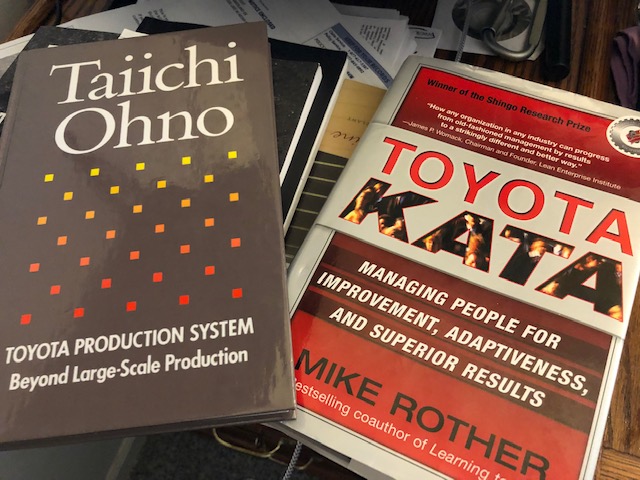
I’m reading some great books about the Toyota Production System (TPS). I started in November with Toyota Kata by Mike Rother, which is written directly, simply and with a cadence that sounded like it was translated from the Japanese. It was not. I then read Toyota Production System by Taiichi Ohno, written with short declarative sentences and punctuated with Socratic questions that were then answered in the next line or paragraph.
It was reminiscent of Tatsuhiko Yoshimura’s writings that were translated for us at GM. Yoshimura san’s technical assistants were born in Japan, educated both there and in the US and translated in the style that I’m reading from Mr. Rother and from the Ohno book. One of my Audible books is The Book of Five Rings (Musashi) which is again, a translation from Japanese. The cadence is there too. I even looked up Iambic Pentameter, which this is not. Maybe it’s lean octameter?
Technical Writing / Writing for Instruction:
In teams I was in and teams that I led; we wrote many technical documents like:
Specifications
- What should the product be and what should the product do?
Procedures
- How do you perform a task? Procedures are written to a standard format and flow for the purpose of communicating to labs, suppliers, technicians, other engineers.
Reports
- Results of evaluations (which were hopefully performed to a procedure or according to a specification) are documented in ‘Evaluation Reports’
Service Bulletins
- Written to a fixed and familiar outline using the minimum of conditional words and maximizing the use objective descriptions. Note: The service bulletin form and guidance are a good way to communicate problems and solutions using an outline or form of CONDITION / CAUSE / CORRECTION.
Experiences:
My first big publication (after the bachelor’s thesis) was as a collaborator on an SAE paper. I wrote the first draft and outline, pretty close to a service bulletin style, simple, declarative. My co-authors tore it up, made hash of it (in my opinion). Not ‘professional’ enough. By the time it was ready for press, it had lots of big words and high sounding third person assertions. (SAE 861029, Integrated Vehicle Systems Diagnostics – Powertrain & Chassis (Co-Author presented to IEEE / SAE Convergence))
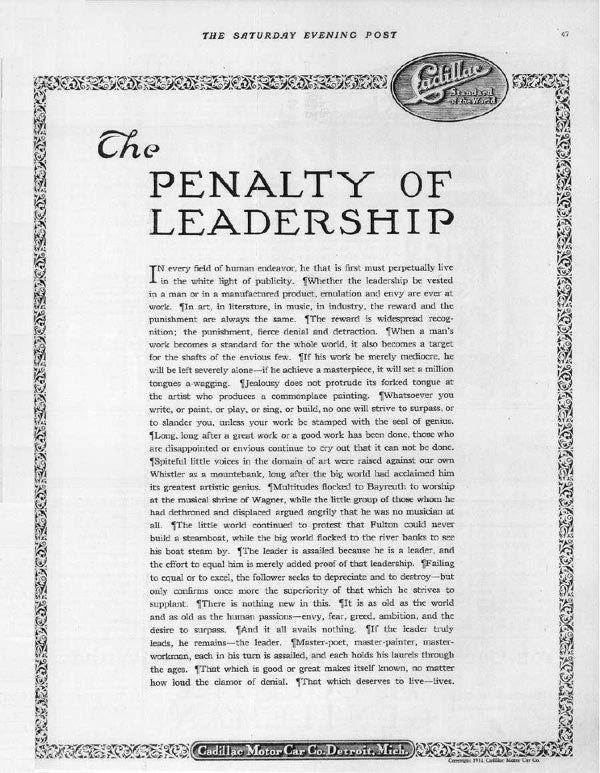
My career from 1984 through about 1991 was as a technical writer in the Cadillac service community. Back to condition / cause / correction, simple declarative, unambiguous (don’t say fully driven / seated and not stripped, instead say, finger start then torque to 7 Nm)
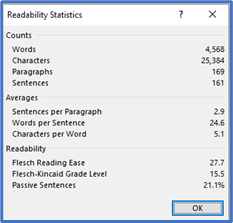
My latest adventure has been as an expert witness / consulting engineer for law firm. I wrote a report for said adventure and the first draft was a failure. I needed to be more lawyerly. After iteration, the result is Grade 15 reading level, 25 words in a sentence. Not very Zen or quality like. Very legalistic.
One of my favorite comedians (the great and powerful Doug Stanhope) teaches us (in his own way) about using big words to show off. Doug is known to respond to a haughty statement full of 10-dollar words with “What, have you been reading smart-F$%* magazine again?” His way of correcting an annoying behavior is with sarcasm and shaming. That’s how I grew up, so I understand it. Don’t make it a go-to. It isn’t endearing and only pays off for crowd work comedians.
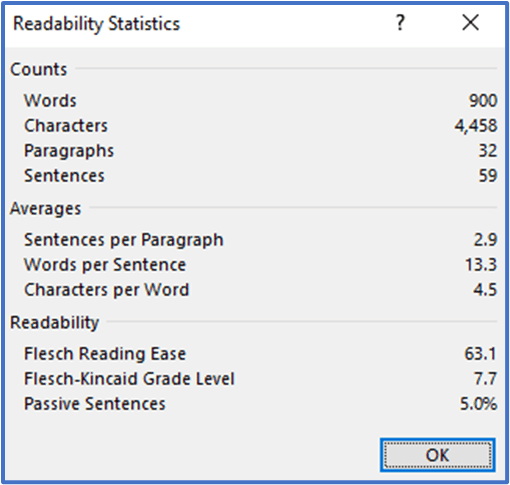
Anyway, here is the reading index for this piece: 7.7 GRADE LEVEL!
- Wheel / Snipe and Celly! I made it look easy.
PS:
I did have to look up Iambic Pentameter. Is that what quality book cadence is? Nope.
Iambic Pentameter is from poetry, the pentameter (Penta meter) is five beats (they call it five ‘feet’). The iamb is a two-syllable word, with second syllable stressed. The Wiki example is “Two Households, Both Alike In Dignity”. I reckon there are five beats there and 2 of the 5 are two syllables. I’m not feeling the second syllable stressed gimmick. I give up.
 Don Wright's Chataqua